-
0
Your Shopping Cart
0 ITEMS IN YOUR CART

Rendering Garden Walls & Retaining Walls: Why Standard Render Fails and the Mapei Solution
Rendering Garden Walls & Retaining Walls: Why Standard Render Fails and the Mapei Solution
Garden walls, retaining walls and raised planters can be some of the most challenging surfaces to render successfully. Unlike a typical house façade, these structures are often exposed to constant moisture, soil contact, water splashback and changing ground conditions. Without the correct preparation and system build-up, even a high-quality decorative render can deteriorate prematurely.
At ProTec Render Supplies, we stock Mapei products that can be used to create a dedicated waterproof render system for these demanding environments, combining waterproofing, reinforced basecoat and a durable decorative finish.
Why do garden walls and retaining walls cause problems?
The biggest challenge when rendering garden walls and retaining walls is moisture. These structures frequently sit in areas where water cannot easily drain away, and the back of a retaining wall may be in direct contact with damp soil.
This creates conditions that conventional render systems are not necessarily designed to withstand.
Common problems include:
- Persistent moisture: Water can penetrate masonry from the ground, through the wall or from the soil behind a retaining structure.
- Salt contamination and efflorescence: Moisture can transport soluble salts through masonry, leaving white deposits on the surface and potentially contributing to deterioration.
- Blistering and debonding: Prolonged dampness and unsuitable substrate conditions can compromise adhesion, causing the render to detach from the wall.
- Cracking: Movement, changes in moisture content and stresses within the substrate can lead to cracking, allowing further water ingress.
- Algae and organic growth: Damp, shaded garden walls can provide ideal conditions for algae, mould and other organic growth.
- Freeze-thaw damage: Water absorbed into vulnerable materials can freeze and expand, potentially worsening existing cracks and surface damage.
- Impact damage: Garden walls are often exposed to knocks from gardening equipment, lawnmowers and general outdoor use.
The result can be a wall that looks good immediately after completion but begins to show staining, cracking, bubbling or areas of failed render over time.
Why can monocouche, standard render and silicone render fail?
Monocouche, traditional cement-based render and silicone thin-coat finishes are all useful products when specified for the correct application. However, using a conventional façade system on a wall exposed to persistent ground moisture can lead to problems if the moisture source and waterproofing requirements have not been addressed.
1. Monocouche render
Monocouche is a popular choice for external walls because it provides a durable, through-coloured finish in a single application. However, it is not a substitute for a dedicated waterproofing system.
On garden walls and retaining walls, moisture can enter through the masonry, joints, cracks or the ground behind the wall. Depending on the product and exposure conditions, this can contribute to staining, salt deposits, cracking and loss of adhesion.
Applying monocouche directly to damp or moisture-contaminated masonry does not resolve the underlying problem. The wall needs to be assessed and prepared correctly, with a suitable system selected for the conditions.
2. Standard sand and cement render
Traditional sand and cement render is widely used on external masonry, but a conventional render mix alone does not provide the same protection as a designed waterproofing system.
Where walls are exposed to ground contact or prolonged moisture, water can migrate through the substrate and render. Salts may then accumulate at the surface or within the render layers, while repeated wetting and drying can contribute to deterioration.
Simply applying another coat of render or paint over the affected area may improve the appearance temporarily without addressing the source of the moisture.
3. Silicone and thin-coat render
Silicone render is valued for its weather resistance, colour options, textured finish and resistance to organic growth, depending on the product selected. However, a silicone finish coat should not be confused with a waterproofing membrane designed to resist ground moisture or water pressure.
A silicone render system is only as reliable as the substrate and the layers beneath it. If moisture is travelling through the wall, the decorative finish alone cannot solve the underlying issue.
For retaining walls, planters and other moisture-prone structures, the more appropriate approach is to consider a complete system that addresses waterproofing first, followed by a reinforced basecoat and a suitable decorative finish.
The solution: Mapei's waterproof render system
Mapei offers a system designed for retaining walls, raised planters, basement walls, plinths, below-DPC zones and other moisture-prone masonry or concrete structures.
Rather than relying on the render finish alone, the system combines a dedicated waterproofing layer, reinforced basecoat and decorative finish to provide protection in demanding environments.
The system specified for these applications includes the following products:
Step 1 – Prepare the substrate
Before any products are applied, the wall must be structurally sound, fully cured, clean and free from laitance, oils, grease and other contaminants. Any organic growth must be treated and removed, and necessary repairs completed.
Correct preparation is essential for the performance of the subsequent layers.
Step 2 – Apply the appropriate waterproofing layer
The Mapei specification identifies two waterproofing options, depending on the application.
Option A: Planiseal 88 – soil-retaining face
Planiseal 88 is specified for the soil-retaining face of the wall.
The specification calls for a final thickness of approximately 2–3mm. Where applied by brush, this requires two to three coats, generally allowing five to six hours between coats and no more than 24 hours between applications.
The product provides a waterproof barrier, resistance to positive and negative water pressure, and adhesion to concrete and masonry. It is also suitable for potable-water structures.
Option B: Mapelastic Foundation – front face of the wall
Mapelastic Foundation is specified as the waterproofing option for the front face of the wall.
The application comprises a first coat of approximately 1mm, applied by roller or trowel, followed by a second coat to achieve a total thickness of approximately 2mm. Detailing materials should be incorporated where required, and the mixed product must be used within the specified working time.
Its specified benefits include waterproof protection, crack-bridging properties, resistance to aggressive ground conditions and protection for concrete and masonry.
Important: These products have different specified applications. Select the appropriate option for the wall construction and exposure conditions, and follow the relevant Mapei technical data sheet.
Step 3 – Apply the reinforced basecoat
Once the waterproofing layer has fully cured, apply Mapetherm AR1 GG as the reinforced basecoat.
The Mapei specification gives a typical overall thickness of 5–6mm and calls for reinforcement using Mapetherm Net.
The mesh must be fully embedded, with minimum 100mm overlaps and continuous reinforcement across transitions between different substrates.
This reinforced layer provides additional mechanical strength, impact resistance and adhesion, helping create a suitable base for the decorative finish.
Allow the basecoat to fully cure before proceeding.
Step 4 – Prime the surface
Once the reinforced basecoat has cured, apply either Silancolor Base Coat or Universal Base Coat, as specified in the system guidance.
Allow the primer to dry in accordance with the relevant technical data sheet before applying the final finish.
Using the correct primer helps prepare the surface for the selected decorative coating.
Step 5 – Choose the decorative finish
The system specification provides two decorative finish options, allowing contractors to select the appearance and performance characteristics most appropriate for the project.
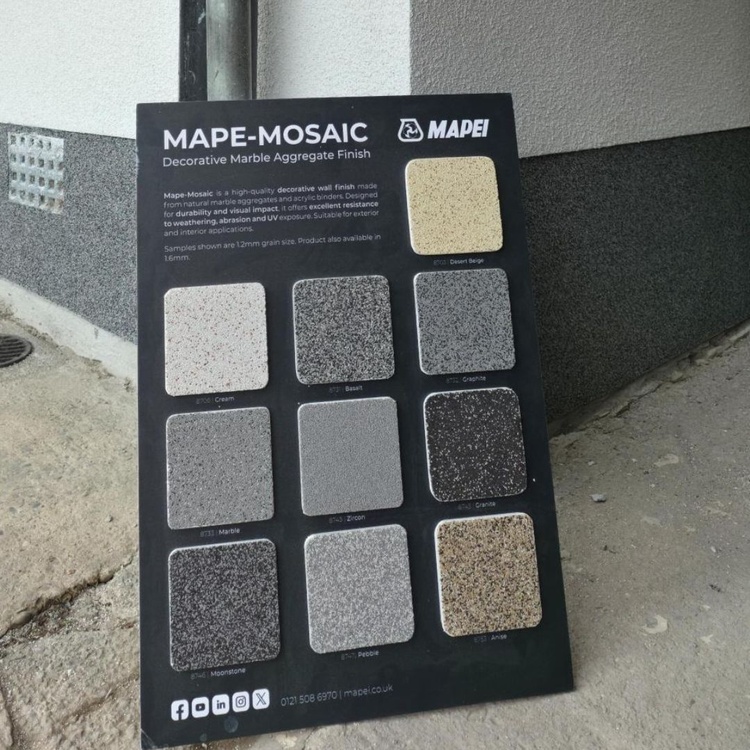
Mape-Mosaic Quartz Render
Mape-Mosaic is a silicone-acrylic-based render containing coloured quartz. It provides a durable textured finish with high mechanical strength and impact resistance.
Key benefits include:
- UV and weather resistance.
- High impact resistance.
- A durable, decorative quartz finish.
- Low maintenance requirements.
It is an option worth considering for garden walls where a textured, robust finish is desired.
Silancolor Tonachino Plus
For projects requiring a silicone-based decorative finish, Silancolor Tonachino Plus is a full silicone thin-coat render.
Its specified benefits include:
- Breathability.
- UV and weather resistance.
- Added protection against algae, mould and fungi.
- Low maintenance.
- A wide selection of colours.
This option allows contractors to achieve a traditional textured silicone-render appearance while using the dedicated waterproofing and reinforced basecoat layers beneath it.
Why use a complete system rather than just changing the render?
When a garden wall or retaining wall repeatedly suffers from render failure, the issue may not be the decorative product itself. It may be the fact that the original system was never designed for the level of moisture exposure.
The Mapei approach addresses the wall in layers:
- Waterproofing to provide a barrier against moisture in the specified application.
- Reinforced basecoat to provide a suitable, reinforced substrate.
- Correct priming to prepare the surface for the selected finish.
- Decorative render to provide the required appearance and weather-resistant finish.
This system-based approach is particularly relevant where moisture exposure is a major consideration and long-term performance matters.
It is important to remember that waterproofing a retaining wall also requires consideration of drainage, ground conditions, water pressure, structural movement and the condition of the existing masonry. The render system should form part of an appropriate overall solution rather than being treated as a replacement for necessary drainage or structural measures.
Looking for a solution for your next garden wall or retaining wall project?
At ProTec Render Supplies, we supply Mapei rendering products and can help contractors identify the products required for their next project.
Whether you're dealing with a failing garden wall, specifying a finish for a new retaining wall or looking for a more suitable approach to moisture-prone masonry, choosing the correct system from the outset is essential.
Contact our team to discuss your project, product requirements and the relevant technical specifications.
*Always consult the latest Mapei technical data sheets and confirm the suitability of the complete system for the specific substrate, exposure conditions and intended application before starting work.*
- Wednesday, October 14, 2026
- Retaining Walls
- ProTec